
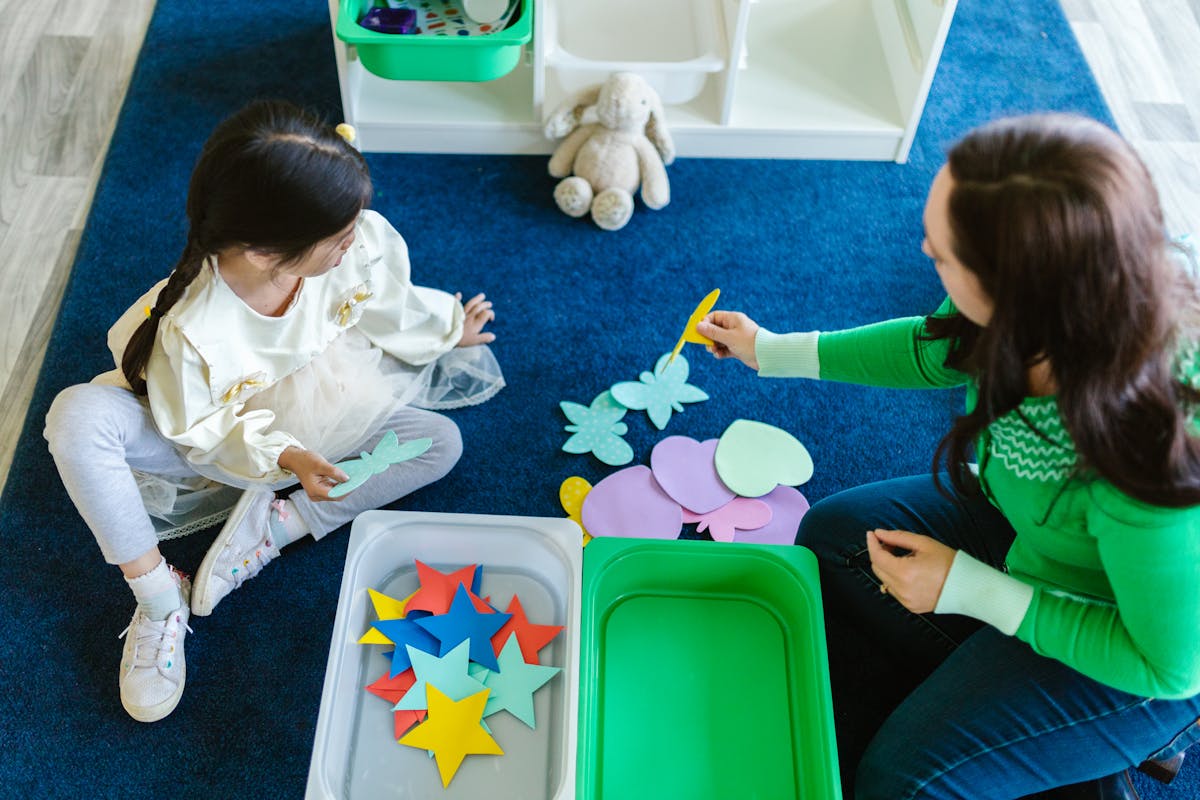
If your child is in Year 1 or Year 2 at a primary school in England, they are working within Key Stage 1 (KS1). This is a crucial phase where the foundations for all future mathematical learning are established.
- What Key Stage 1 covers and how it is structured
- Year 1 expectations across all maths domains
- Year 2 expectations and how they build on Year 1
- How assessment works, including KS1 SATs
- Practical ways to support your child at home
What Is Key Stage 1?
Key Stage 1 is the first formal stage of the National Curriculum in England, covering two academic years:
| Year Group | Ages | Key Focus |
|---|---|---|
| Year 1 | 5–6 | Building foundations: counting, number bonds, basic shapes |
| Year 2 | 6–7 | Extending skills: times tables, fractions, telling time to 5 mins |
The maths curriculum is organised around domains: Number & Place Value, Addition & Subtraction, Multiplication & Division, Fractions, Measurement, Geometry, and Statistics (Year 2 only).
The National Curriculum represents the minimum schools must teach. Many schools supplement with additional activities, investigations, and enrichment.
Year 1 Curriculum Expectations
Number and Place Value
- Count to and across 100 from any given number
- Count in multiples of 2s, 5s, and 10s
- Read and write numbers to 100 in numerals
- Understand tens and ones (place value)
- Identify one more and one less to 100
Addition and Subtraction
- Read, write, and interpret +, −, and = signs
- Use number bonds within 20
- Add and subtract one-digit and two-digit numbers to 20
- Solve one-step word problems
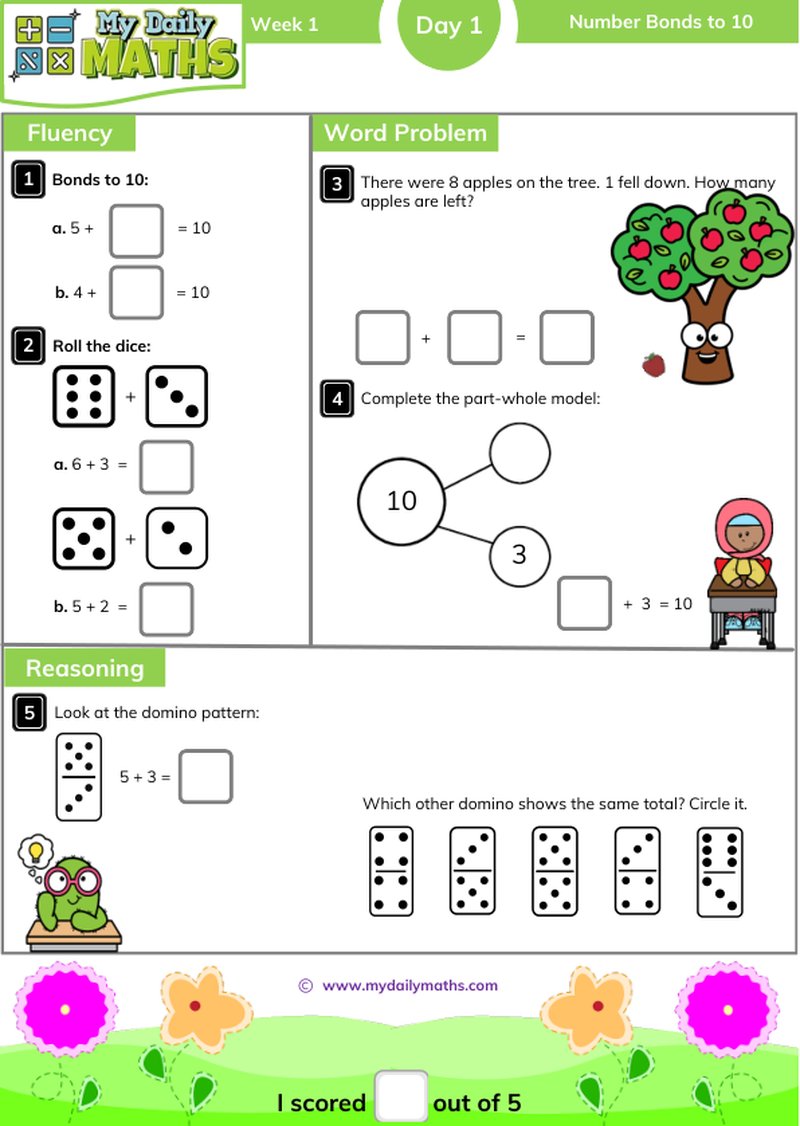
Five weeks of progressive daily practice covering number bonds, adding within 10, and adding within 20.
Download FreeYear 1 Worksheets — Colourful, Engaging & Curriculum-Aligned
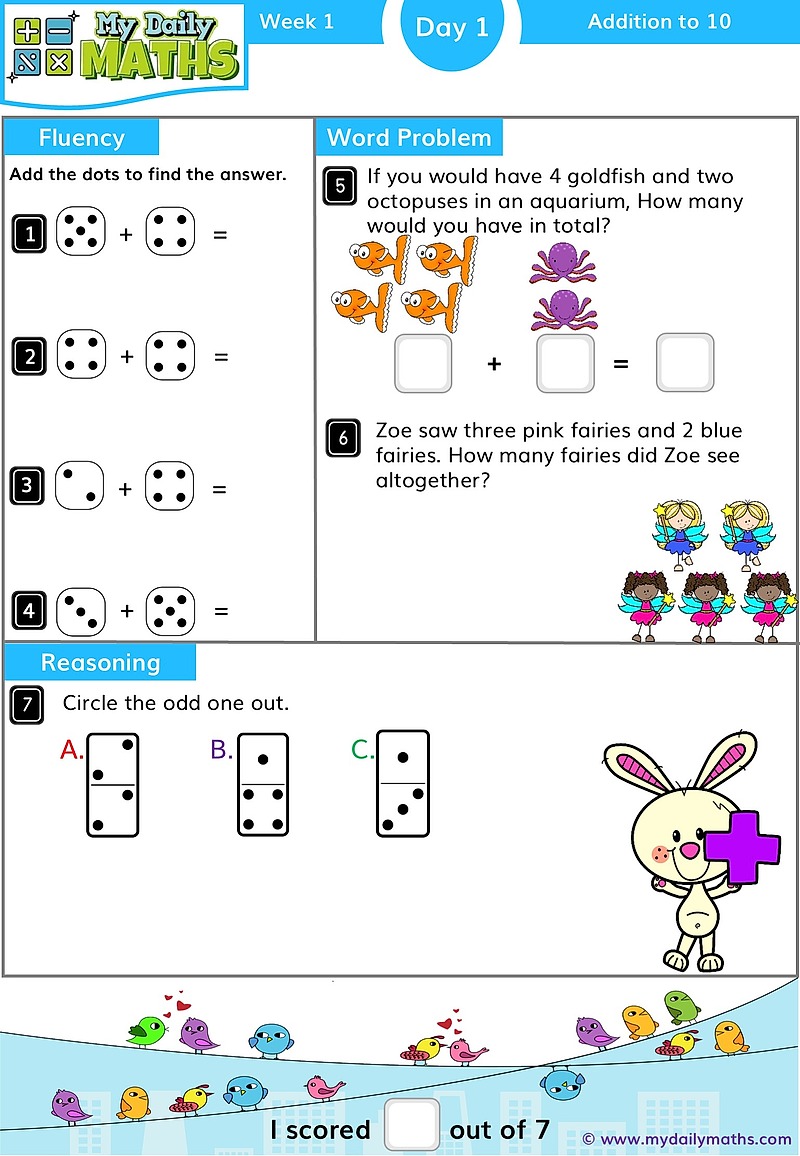
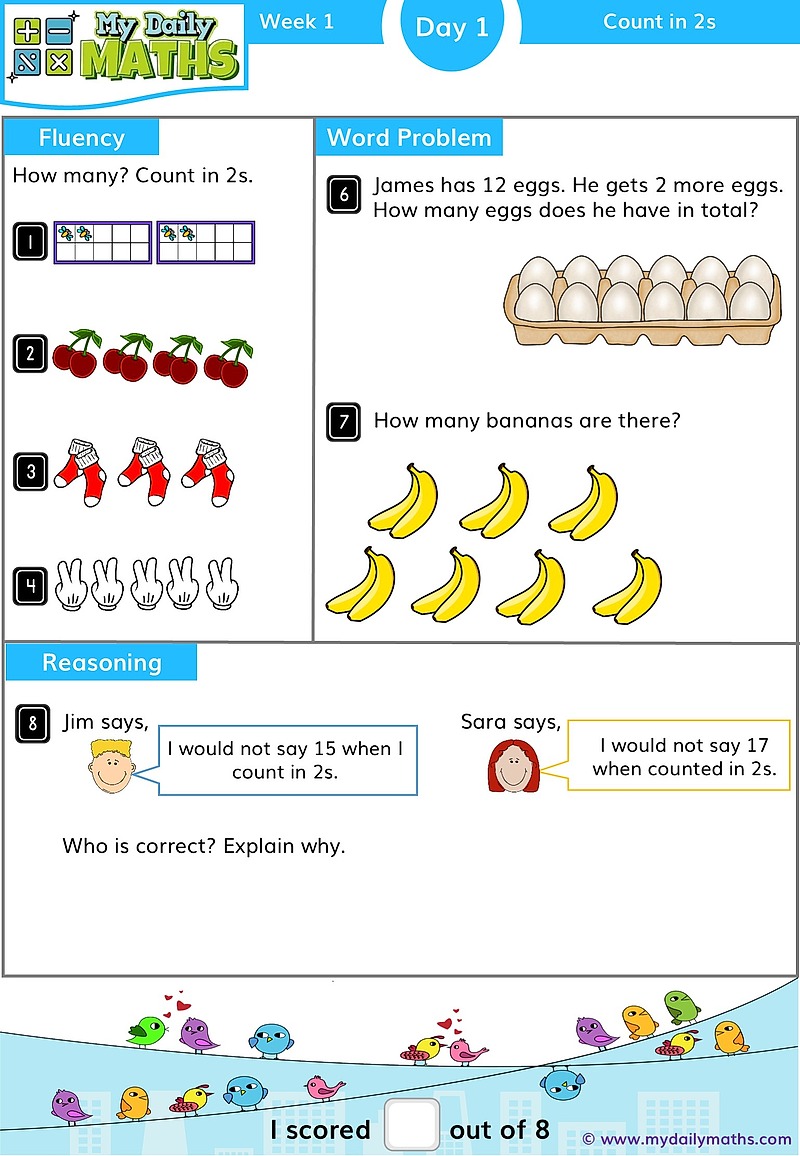
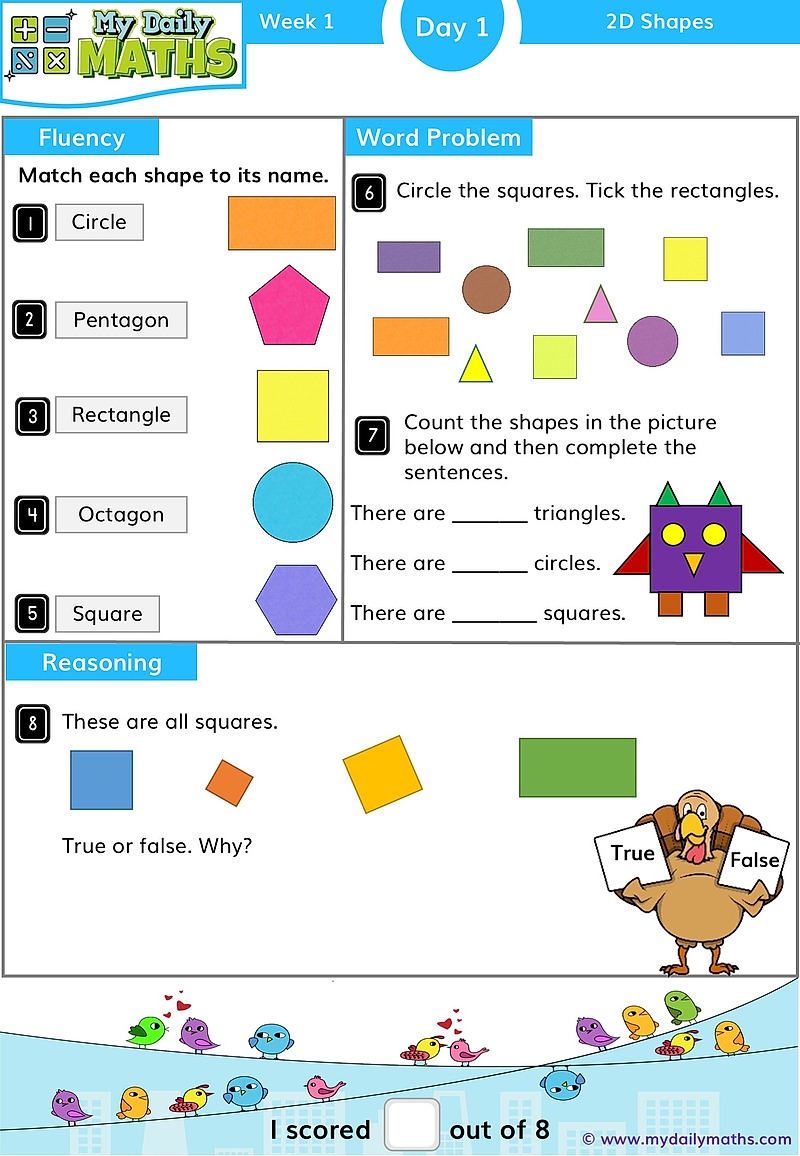
Each worksheet includes fluency practice, word problems, and reasoning — all on a single, printable page.
Multiplication, Division, and Fractions
- Solve problems using grouping and sharing (early multiplication/division)
- Recognise and name halves and quarters
Measurement and Geometry
- Compare lengths, weights, and capacities
- Tell the time to the hour and half past
- Name common 2D and 3D shapes
- Describe position and direction
Year 2 Curriculum Expectations
Year 2 builds on Year 1 foundations, extending and deepening understanding. The work becomes more demanding.
Number and Place Value
- Count in steps of 2, 3, and 5 from 0
- Recognise place value in two-digit numbers
- Compare and order numbers using <, >, and =
- Read and write numbers to at least 100 in numerals and words
Addition, Subtraction, Multiplication, and Division
Year 2: Key Calculation Milestones
By end of Year 2, children should recall these facts quickly and accurately.
Fractions
- Extend understanding to thirds
- Find fractions of lengths, shapes, and quantities
- Write simple fractions (e.g. ½ of 6 = 3)
- Recognise equivalence: 2/4 = ½
Measurement
- Choose and use appropriate standard units
- Tell and write the time to five minutes
- Find combinations of coins, solve money problems
Statistics (New in Year 2)
- Interpret and construct pictograms, tally charts, and block diagrams
- Ask and answer questions by counting, totalling, and comparing data
Year 2 Worksheets — Building on Year 1 Foundations
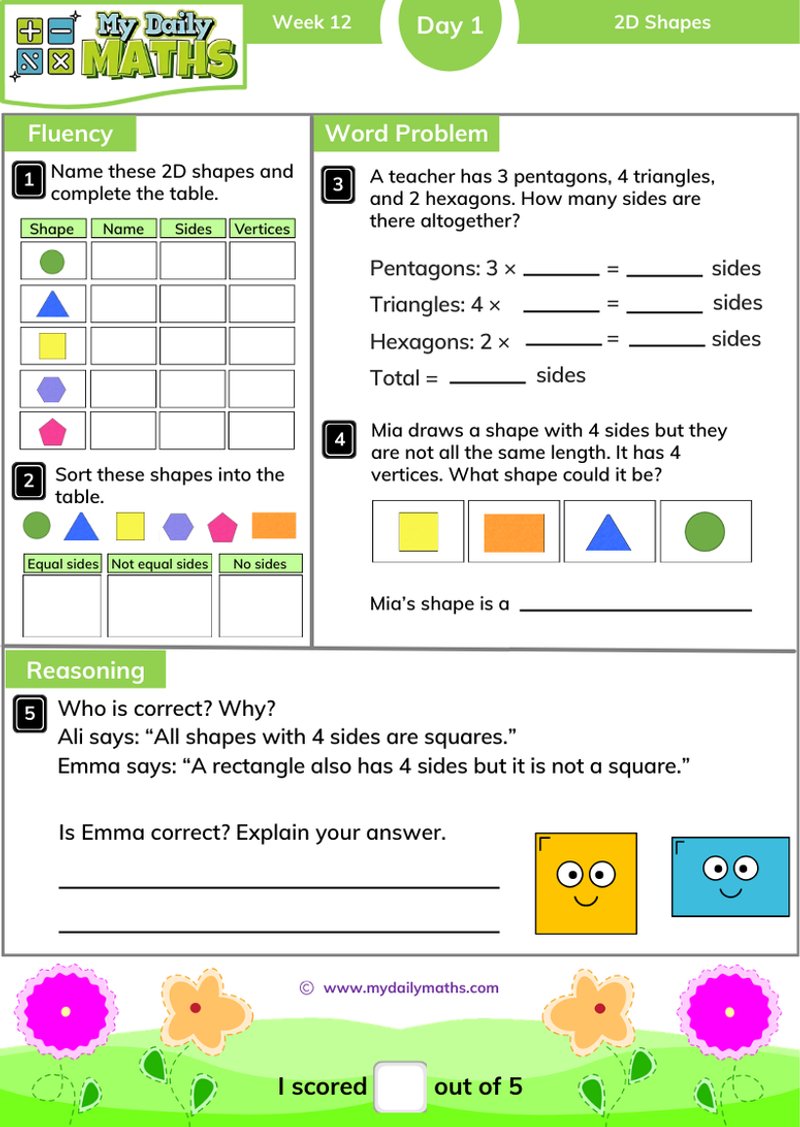
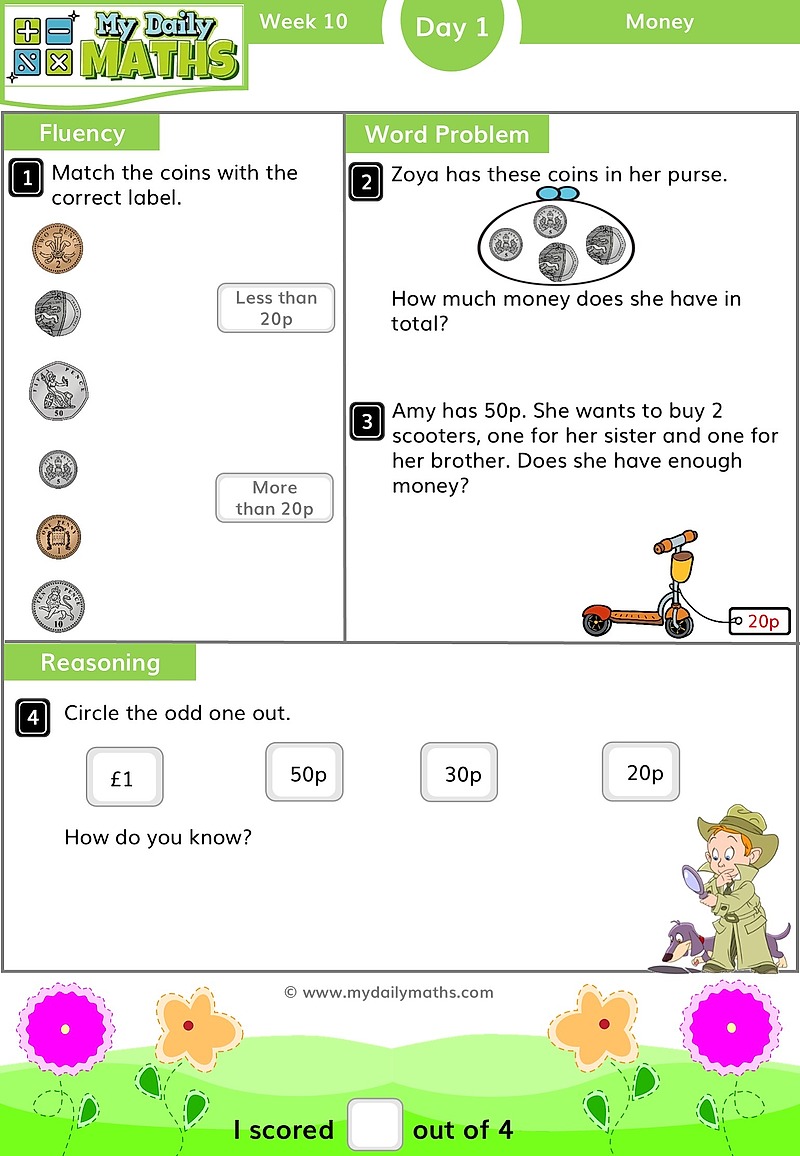
Year 2 worksheets cover more challenging content while keeping the same engaging, child-friendly format.
How Assessment Works at KS1
Teacher Assessment
Teacher assessment is the primary method at KS1. Teachers use professional judgement to assess each child as:
| Standard | What It Means |
|---|---|
| Working towards | Not yet meeting age-related expectations |
| Expected standard | Meeting the expectations for their year group |
| Greater depth | Exceeding expectations, applying knowledge in new contexts |
KS1 SATs
At the end of Year 2, children may sit two maths papers:
- Paper 1 (Arithmetic) — calculation skills and fluency
- Paper 2 (Reasoning) — applying knowledge and explaining thinking
From the 2023–2024 academic year, KS1 SATs became optional for schools in England. Some schools still use them for standardised data. Ask your child’s teacher if you’re unsure.
How to Support Your Child at Home
- Daily practice — 10–15 minutes of focused maths each day
- Real-life connections — cooking, shopping, telling the time, board games
- Communication — ask the teacher which topics to focus on at home
- Positive attitude — avoid saying “I was never good at maths”
Maths is not just a school subject — it is a tool for understanding the world. Cooking (measuring ingredients), shopping (counting coins), telling the time, and playing board games all use mathematical thinking naturally.
Over 180 worksheets covering every KS1 topic. Three-section format: fluency, word problems, reasoning.
Year 1 Collection Year 2 CollectionFree Maths Worksheets
Download our free, curriculum-aligned worksheets for Year 1 and Year 2. Practise daily to build fluency and confidence.
Browse all worksheetsMy Daily Maths
We create free, curriculum-aligned maths worksheets for UK primary school children. Our resources are designed by educators and aligned to the National Curriculum to support daily maths practice at home.
View all articles