
Starting school is a milestone for every family, and Year 1 marks the beginning of a more structured approach to mathematics. The England National Curriculum sets out clear expectations for maths at every year group, and understanding these can help you support your child’s learning at home with confidence.
This guide walks through every major area of the Year 1 maths curriculum. We explain what the National Curriculum expects, give practical examples, and suggest ways you can help at home.
- Number and place value — counting to 100, reading and writing numbers
- Addition and subtraction — number bonds, solving problems to 20
- Measurement — length, weight, capacity, and telling the time
- Geometry — recognising 2D and 3D shapes, position and direction
- Fractions — understanding halves and quarters
Number and Place Value
Number and place value is the foundation of everything else in primary mathematics. In Year 1, children are expected to:
- Count reliably to and across 100, forwards and backwards, from any given number
- Count in multiples of twos, fives, and tens (e.g. 2, 4, 6, 8, 10)
- Read and write numbers to 100 in both numerals and words
- Understand place value — knowing that 47 is made up of four tens and seven ones
- Identify one more and one less than any given number up to 100
Place Value Example
Children learn that each digit in a number has a value based on its position.
Understanding what each digit represents is crucial for later mathematics. A child who grasps that 47 means “4 tens and 7 ones” has a solid foundation for addition, subtraction, and mental arithmetic.
How Parents Can Help at Home
- Count steps as you walk upstairs together
- Ask “What is one more than 36?” during car journeys
- Point out numbers on doors, buses, and price tags when you are out
- Play games where you take turns counting on from a given number
- Practise counting backwards from 20 at bath time
Addition and Subtraction
Addition and subtraction form a major part of the Year 1 curriculum. By the end of the year, children should be able to:
- Read, write, and interpret statements with +, −, and = signs
- Represent and use number bonds and related subtraction facts within 20
- Add and subtract one-digit and two-digit numbers to 20, including zero
- Solve one-step word problems using concrete objects and pictures
Number Bonds to 10
Number bonds are pairs of numbers that add together to make a total. Knowing bonds to 10 by heart is essential for mental arithmetic.
A number bond is a pair of numbers that add together to make a specific total. For example, the number bonds for 10 include 0+10, 1+9, 2+8, 3+7, 4+6, and 5+5. Knowing these by heart gives children a powerful tool for mental calculation.
How Parents Can Help at Home
Practise number bonds regularly. Hold up fingers and ask how many more are needed to make 10. Use building blocks or buttons to make addition and subtraction tangible.
Structured daily practice covering number bonds, adding within 10, and adding within 20. Five weeks of progressive exercises.
Download Free WorksheetsSample Worksheets — Addition to 10
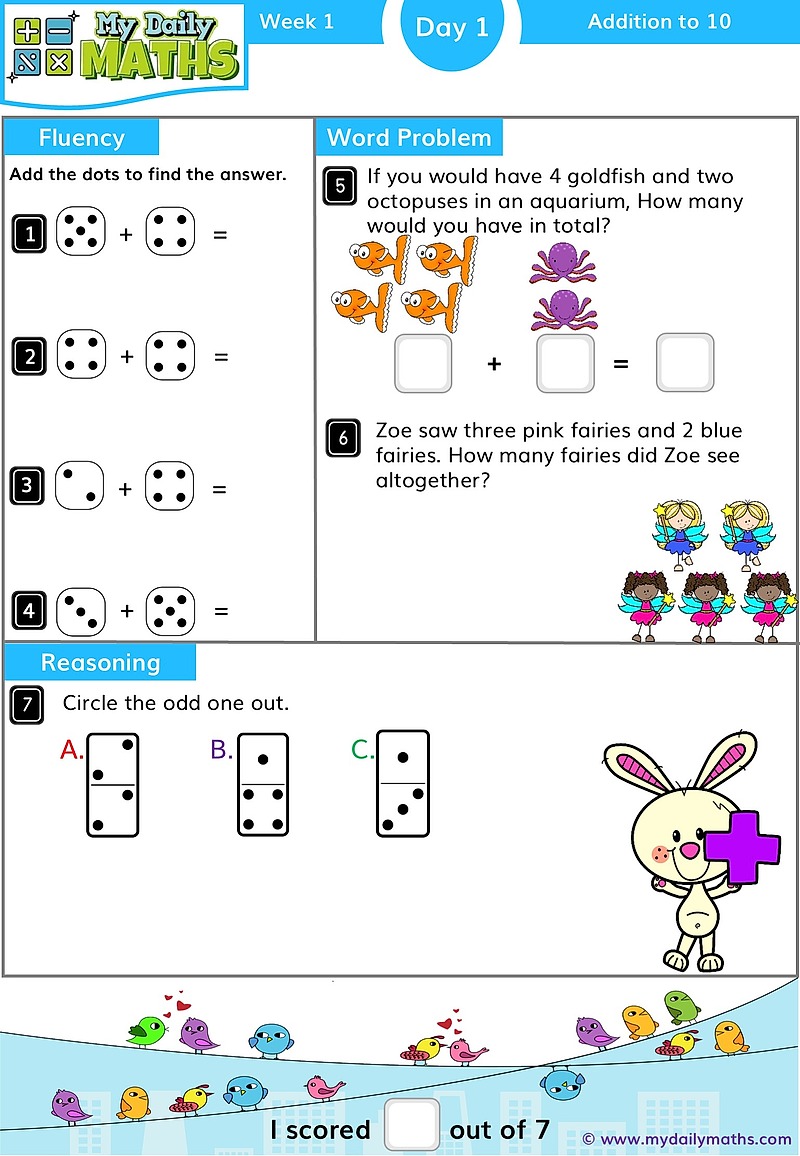
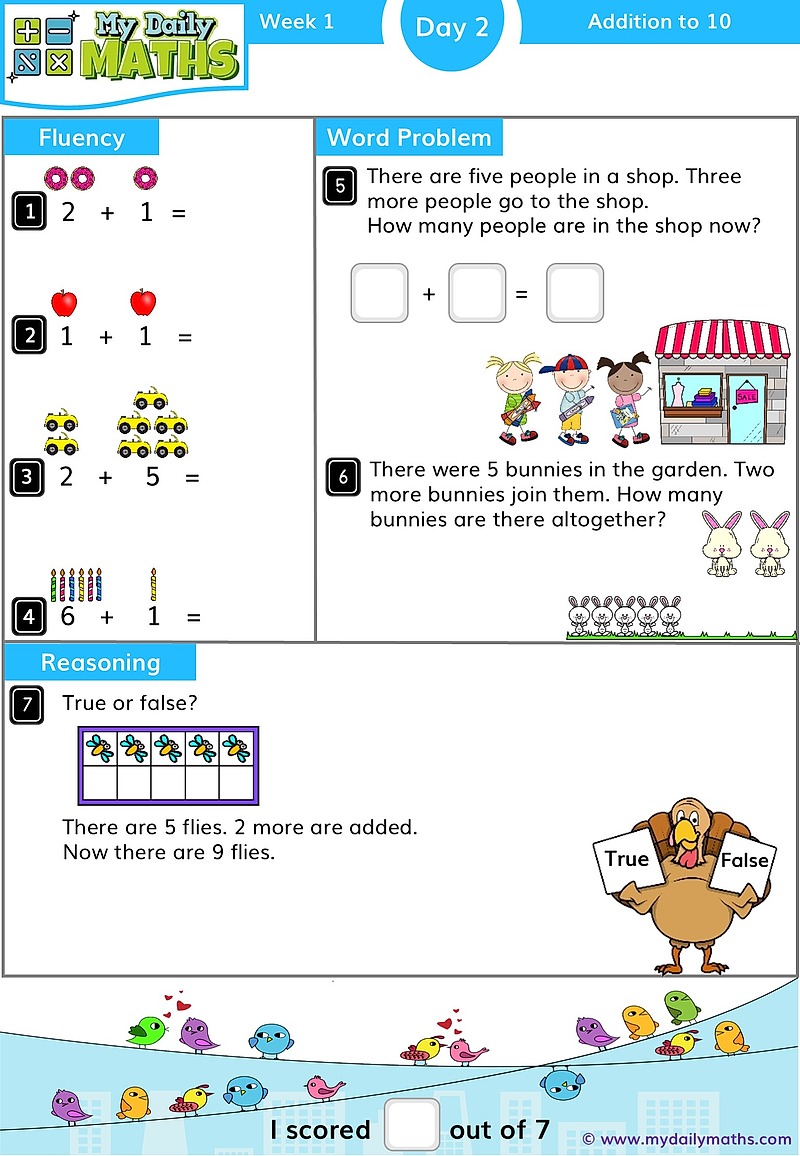
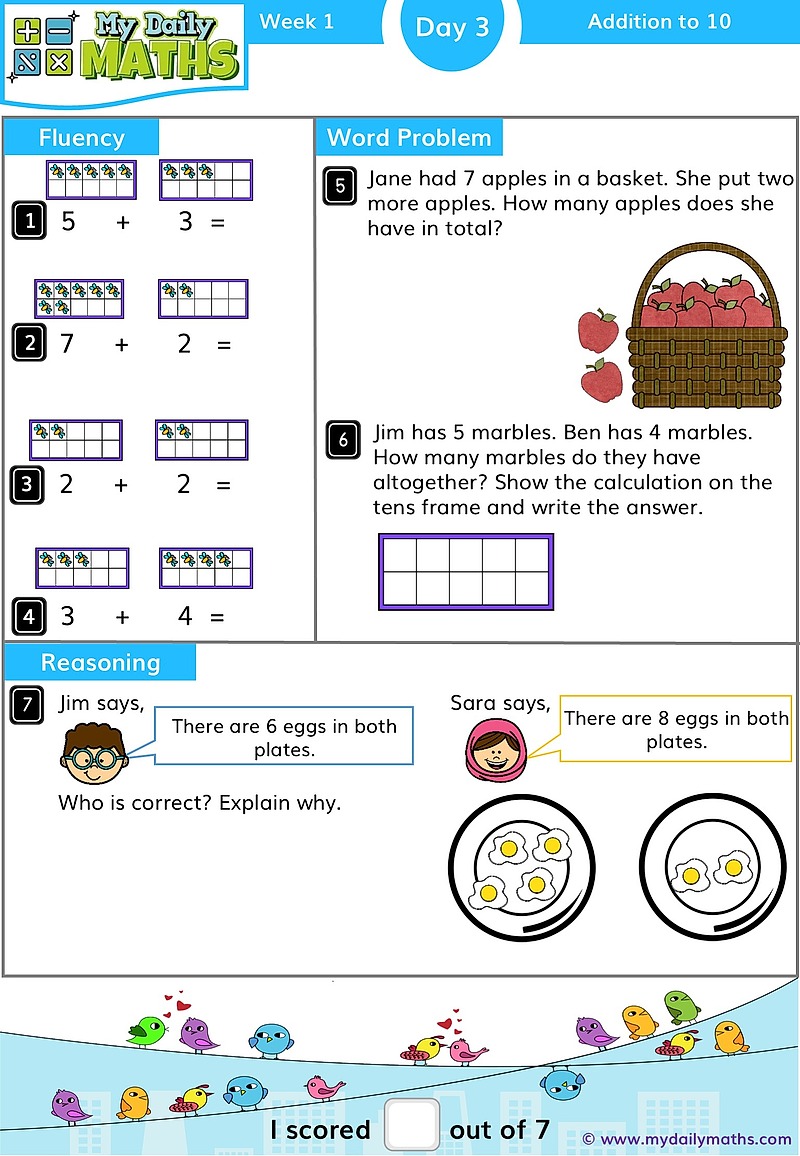
Our free addition worksheets include fluency exercises, word problems, and reasoning challenges — all on a single page.
Measurement
Measurement in Year 1 covers a surprisingly wide range of skills. Children learn to compare, describe, and solve practical problems across four areas:
| Area | What Children Learn | Key Vocabulary |
|---|---|---|
| Length & Height | Compare and measure using standard and non-standard units | long, short, tall, longer, shorter |
| Mass & Weight | Compare objects by weight, begin using kilograms | heavy, light, heavier than, lighter than |
| Capacity & Volume | Compare containers, begin using litres | full, empty, half full, quarter full |
| Time | Tell the time to the hour and half past | o’clock, half past, earlier, later |
Telling the Time — Year 1 Expectations
3 o’clock
Half past 3
By the end of Year 1, children should confidently read times at the hour and half past on an analogue clock.
This is one of the easiest topics to practise at home:
- Cooking — measure ingredients, compare amounts (“Which jug has more?”)
- Gardening — measure plant growth week by week with a ruler
- Shopping — compare weights of items, handle real coins
- Daily routine — “It is half past three, time for your snack!”
Structured practice for comparing lengths, weights, and telling the time.
Measurement Worksheets Telling Time WorksheetsSample Worksheets — Money & Telling Time
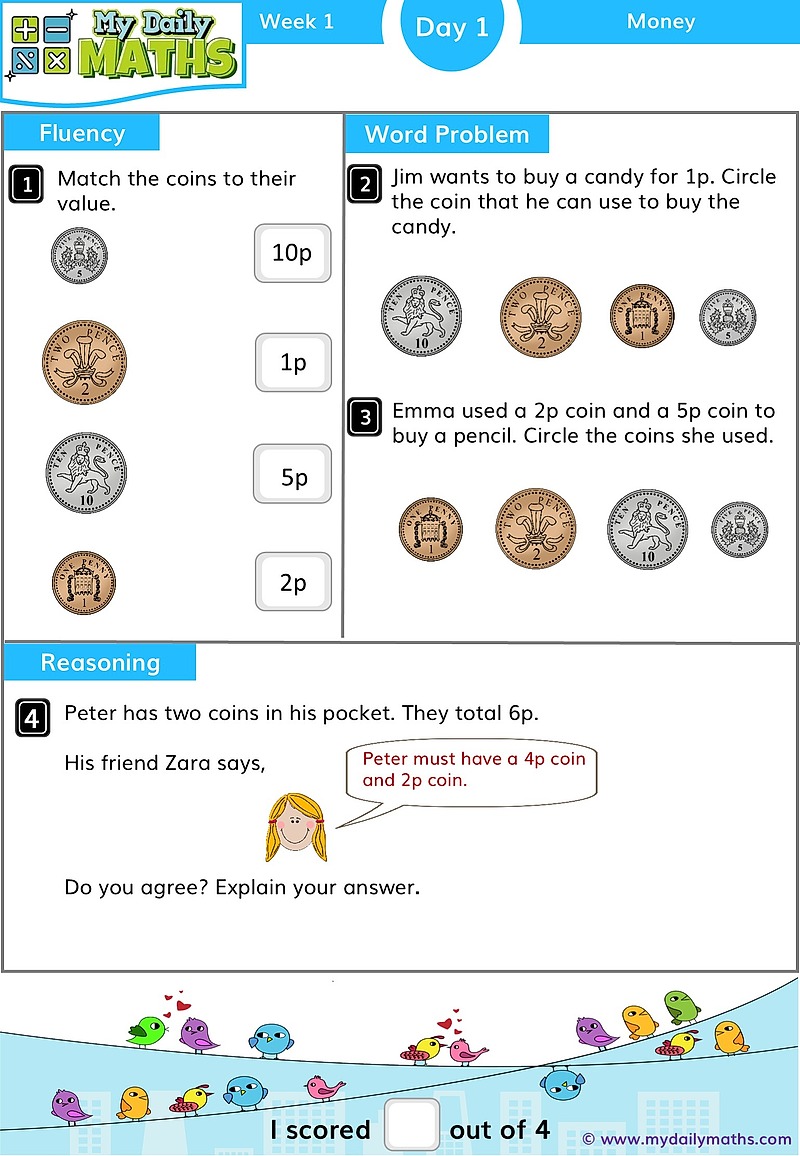
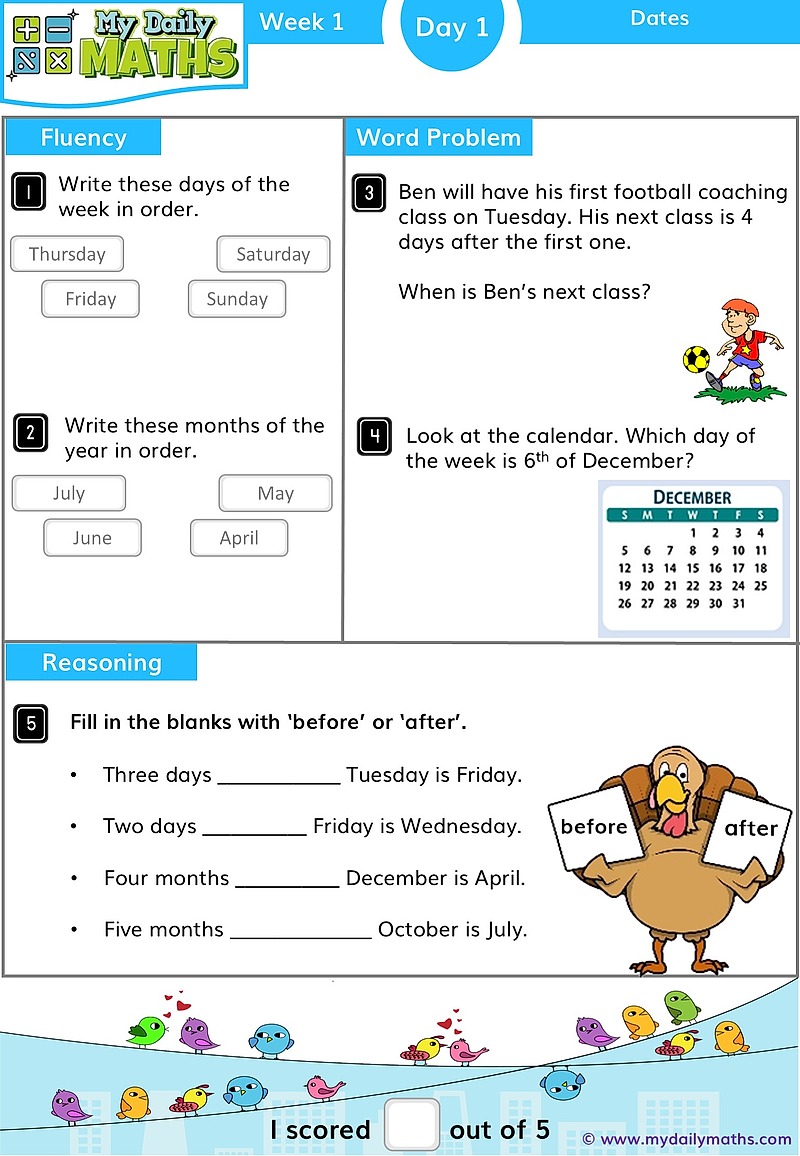
Our money and time worksheets use real-life scenarios to make measurement practice meaningful and fun.
Geometry: Properties of Shapes
In Year 1, children learn to recognise, name, and describe common 2D and 3D shapes.
- Rectangles (including squares) — 4 sides, 4 corners
- Circles — 1 curved side, 0 corners
- Triangles — 3 sides, 3 corners
- Cuboids (including cubes) — 6 faces
- Pyramids, Spheres
- Cylinders, Cones
Year 1 Shape Properties
Square
4 sides, 4 corners
Circle
0 sides, 0 corners
Triangle
3 sides, 3 corners
Children describe shape properties using everyday language: sides, corners, flat, curved, round.
Walk around your home or neighbourhood with your child. Can they spot rectangles in windows, circles in wheels, or cylinders in tin cans? Building with blocks naturally develops understanding of 3D shapes.
Sample Worksheet — 2D Shapes
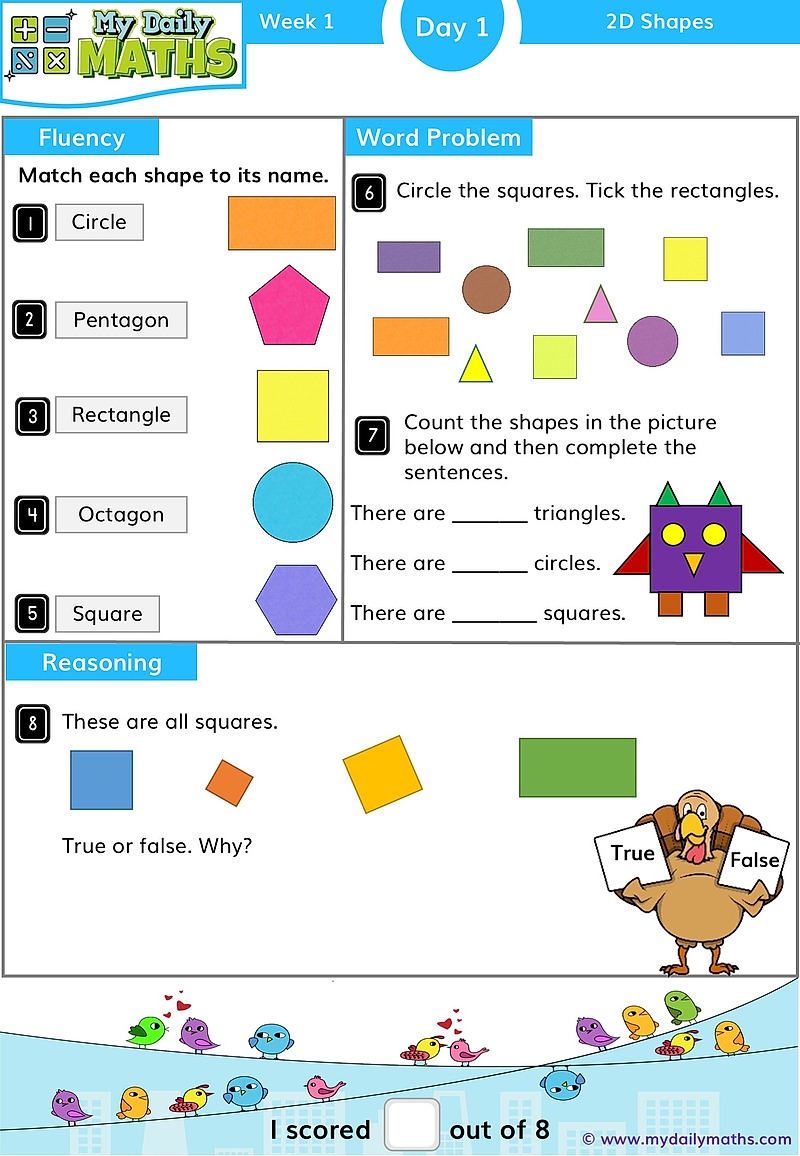
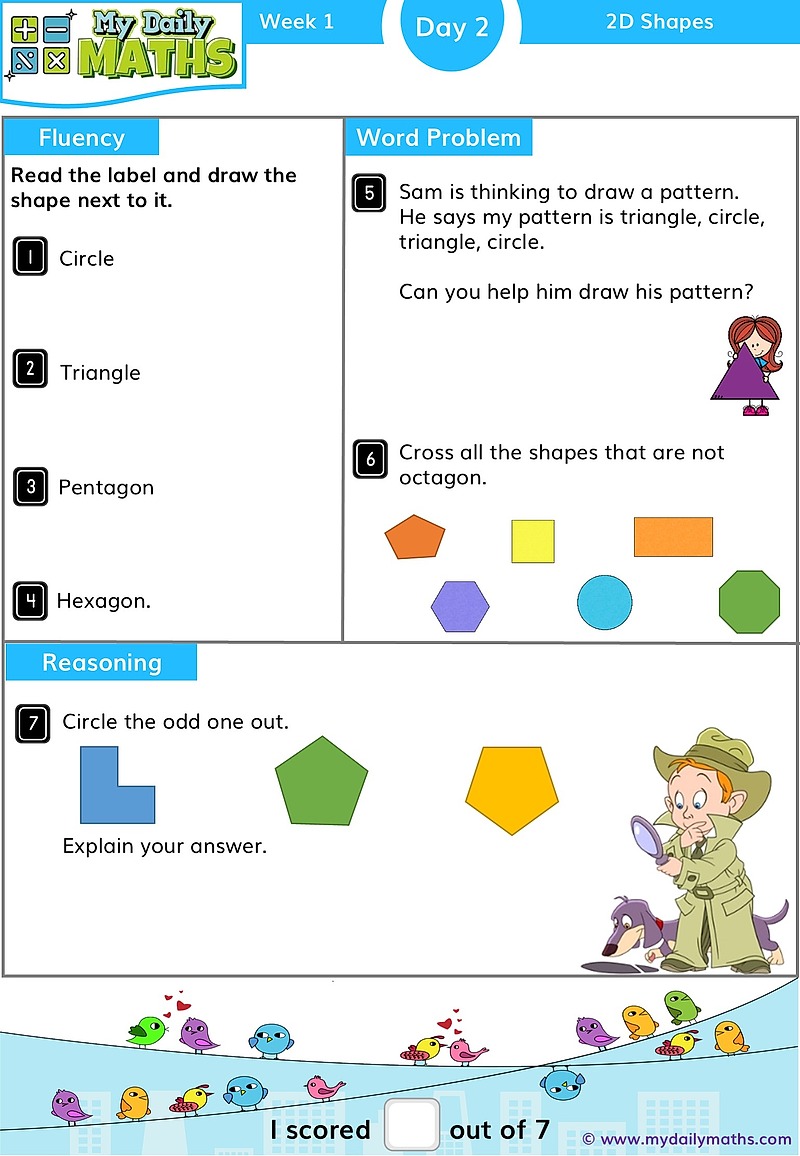
Our shapes worksheets help children identify, name, and describe 2D shapes with engaging activities.
Geometry: Position and Direction
Year 1 children learn to describe position, direction, and movement using mathematical vocabulary:
- Position: left, right, top, middle, bottom, above, below, between
- Movement: forwards, backwards, up, down
- Turns: whole turn, half turn, quarter turn, three-quarter turn
Types of Turns
Half Turn
Quarter Turn
Whole Turn
Children learn to describe turns and use them to give directions.
Give directional instructions: “Put the book on top of the table,” “Stand behind the chair,” or “Can you turn a quarter turn to the right?”
Fractions
Fractions are introduced gently in Year 1. Children learn to:
- Recognise, find, and name a half as one of two equal parts
- Recognise, find, and name a quarter as one of four equal parts
- Understand that fractions must represent equal parts
Halves and Quarters
½
One half — 2 equal parts
¼
One quarter — 4 equal parts
Visual models help children understand that fractions represent equal parts of a whole.
- Cut a sandwich into two equal halves or four quarters
- Share grapes equally: “Can you find half of 8 grapes?”
- Fold paper in half to show two equal parts
- Share sweets equally between two or four people
Sample Worksheet — Fractions: Halving
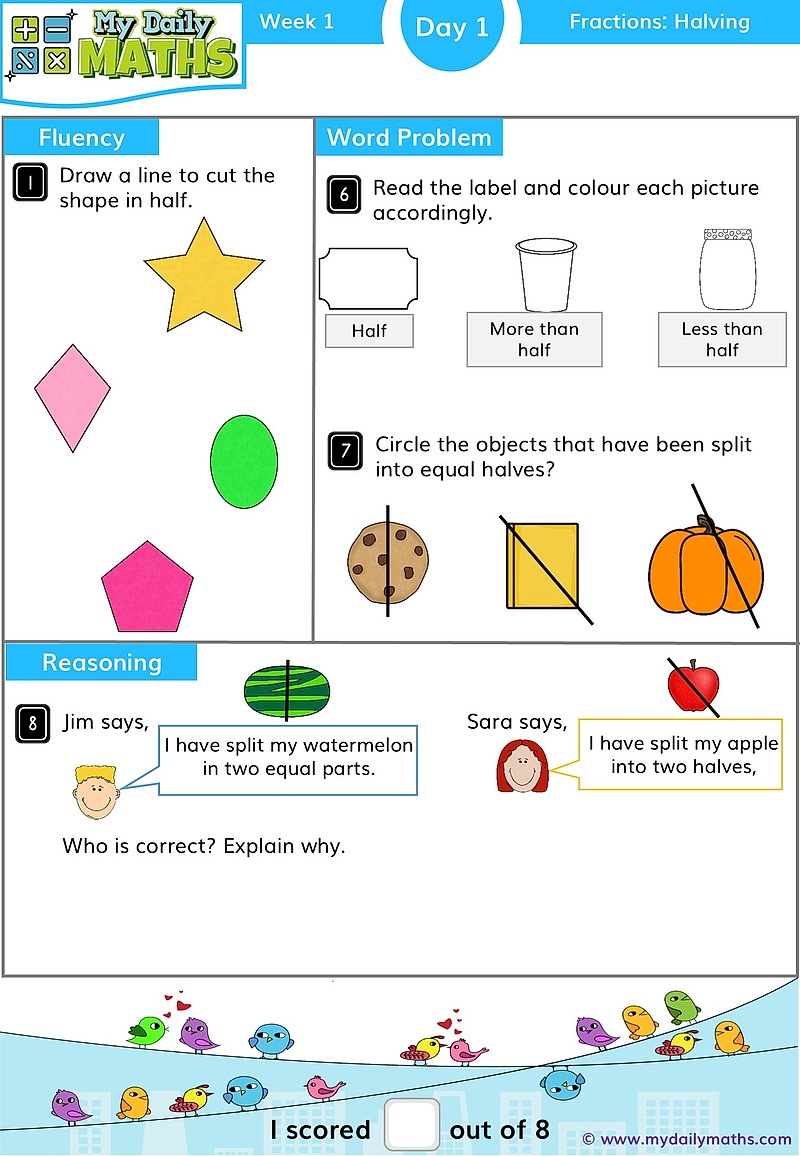
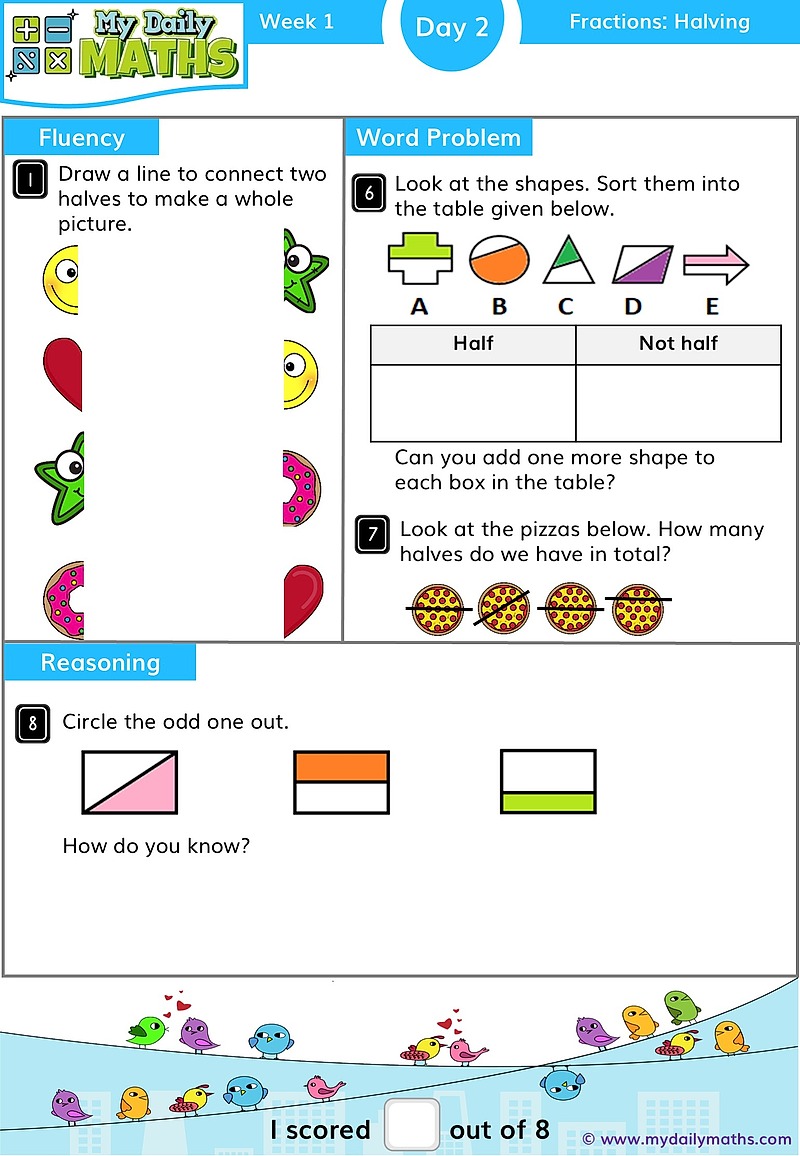
Children practise finding halves of shapes and objects with colourful, engaging activities.
Bringing It All Together
The Year 1 maths curriculum is broader than many parents expect, but children do not need to master everything overnight. The most effective support is short, regular practice.
Every child develops at their own pace. Celebrate effort as much as results, and never be afraid to revisit earlier concepts if your child needs more time to consolidate their understanding.
Structured, curriculum-aligned practice for every topic in this guide. Free to download and print, no registration required.
Explore Year 1 CollectionFree Maths Worksheets
Download our free, curriculum-aligned worksheets for Year 1 and Year 2. Practise daily to build fluency and confidence.
Browse all worksheetsMy Daily Maths
We create free, curriculum-aligned maths worksheets for UK primary school children. Our resources are designed by educators and aligned to the National Curriculum to support daily maths practice at home.
View all articles